
IceBasin Buyer Guide
Cold Plunge Water Chemicals: Chlorine, Bromine, and Peroxide Compared
I use cold work like a training tool, not a toughness ritual, and that changes how I answer this question. As an Amazon Associate, IceBasin earns from qualifying purchases.
Practical takeaway
Judge gear by whether it makes the habit easier to maintain, easier to clean, and easier to measure, not by how extreme it looks.
Safety / watch-out
The expensive mistake on this site is buying for fantasy usage. If the setup feels annoying, loud, or high-maintenance, you will stop using it.
Best for
comparing tubs, accessories, and setup decisions without hype
What matters most
price-to-usefulness decisions, maintenance reality, and comfort tradeoffs
Big caution
do not pay premium prices for features that will not change your actual routine
I use cold work like a training tool, not a toughness ritual, and that changes how I answer this question. As an Amazon Associate, IceBasin earns from qualifying purchases.
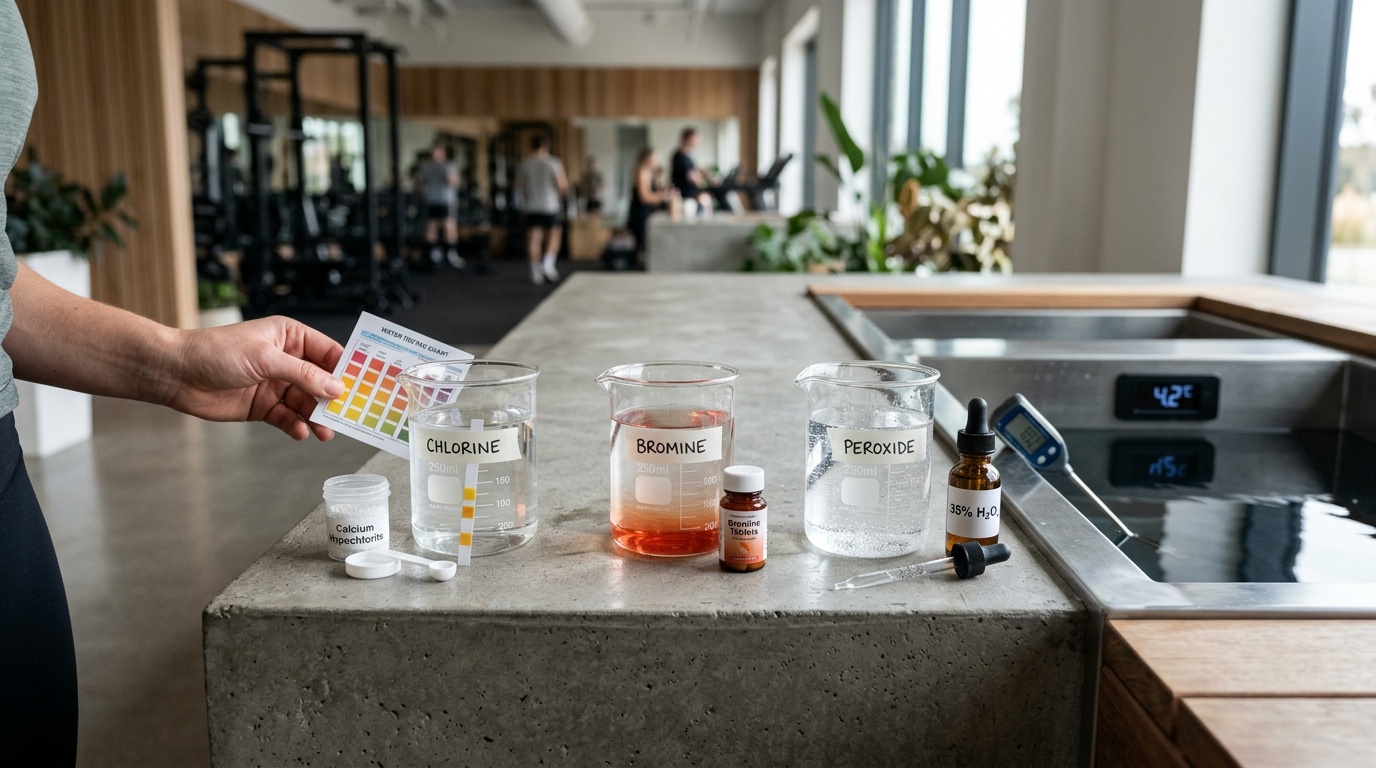
I treat water quality as part of the recovery session. My starting choice for a recirculating cold plunge is chlorine when the equipment manufacturer permits it: the residual is straightforward to measure, and the sanitation framework is well established. Bromine is a reasonable alternative in an approved system. Hydrogen peroxide needs closer scrutiny because an oxidizer is not automatically a complete sanitizer.
The best cold plunge tub maintenance chemicals are the ones your tub supports, your treatment label specifies, and your testing routine can verify. Clear water alone does not tell you whether that water is adequately disinfected.
My coaching rule: if you cannot verify the water, skip the plunge. One missed recovery session is a better trade than gambling on a shared bath.
1. Chlorine, bromine, and peroxide compared
Start with the entire system: tub surface, seals, plumbing, chiller, filtration, and actual water volume. Compatibility with the shell alone is not enough. Then choose a treatment program you can maintain through normal use, busy days, and time away.
| Option | Useful role | Main tradeoff | My judgment |
|---|---|---|---|
| Chlorine | Primary sanitizer with a measurable free-chlorine residual | Requires pH control, testing, and an approved formulation | My default for compatible equipment |
| Bromine | Primary sanitizer in an approved bromine program | Startup chemistry and delivery method need system-specific instructions | A valid alternative; do not assume a spa floater suits your plunge |
| Hydrogen peroxide | Oxidizer in some complete water-care programs | A peroxide reading alone does not establish adequate disinfection | Use within a documented program with clear sanitation instructions |
Compare ongoing workload as well as price. Count testing supplies, filter changes, water replacement, cleaning, and treatment consumption. A cheap bottle becomes expensive if it encourages an unsuitable program or damages the chiller.
2. Cold water still needs a sanitation plan
Every entry adds sweat, skin debris, cosmetics, and microorganisms. Small water volume means those inputs matter quickly. A team rotating through a plunge creates a different maintenance problem from one person using it after a shower.
Filtration, oxidation, and sanitation do different jobs
Filtration removes material within the filter’s capabilities. Oxidation helps address certain contaminants. Sanitation controls microorganisms under defined conditions. A treatment can perform more than one function, but establish that from its label rather than infer it from the word “clean.”
The EPA distinguishes oxidizer products from registered sanitizers. “Shock” on a container is not sufficient evidence that it disinfects recreational water.
UV and ozone can be components of a designed treatment system. They do not make dirty surfaces, poor circulation, or missed maintenance irrelevant. For a system marketed as requiring no added sanitizer, request its operating limits, cleaning schedule, and suitability for your number of users.
Do not transfer warm-water kill times to an ice bath
Disinfection depends on concentration, contact time, temperature, pH, and the organism involved. The CDC’s example chlorine kill times use water at 77 degrees Fahrenheit, pH 7.5, and specified chlorine conditions. They do not validate the same timing at 40 degrees.
Lower temperature is not a sanitation certificate. Neither is transparency. Use a documented treatment program instead of judging microbiological safety by how inviting the water looks.
3. Chlorine: my starting point for compatible tubs
Chlorine’s practical advantage is accountability. Measure free chlorine, compare it with the permitted range, and check whether the residual holds between uses. That makes troubleshooting more disciplined than adding an unmeasured splash whenever the water seems stale.
Free chlorine and total chlorine are different readings. Use the parameter named in your program. A total-chlorine result alone does not establish that enough free chlorine remains available.
Which ppm target should you use?
There is no single number to copy across every cold plunge. As hot-tub reference values, the CDC lists chlorine at least 3 ppm, bromine at 4-8 ppm, and pH at 7.0-7.8. Those are hot-tub recommendations, not a universal cold-plunge specification.
For contrast, Plunge’s All-In Commercial Max instructions specify a free-chlorine target of 1-3 ppm for that model and defer to local requirements. Do not transplant that target to another tub. Follow the applicable product label, equipment instructions, and local requirements together. Resolve conflicts with the manufacturer or qualified operator before use.
Choose the formulation, not just the chemical name
Liquid, granular, and tablet products are not interchangeable by spoonful. Concentration and additional ingredients matter. Do not substitute scented or splashless household bleach, add stabilizer casually, or install a floater unless your instructions allow it.
Chlorine efficacy changes with pH. CDC notes that rising pH reduces its germ-killing ability, while overly low pH can damage plumbing. Correcting pH is part of sanitation, not merely a comfort adjustment.
My equipment judgment: buy a suitable DPD free-chlorine and pH test kit before extra additives. Confirm its measurement range and interference precautions for your program. CDC prefers DPD testing over strips for accuracy.
4. Bromine: a workable alternative with its own rules
Bromine is an established recreational-water disinfectant. Its chemistry is less sensitive than chlorine’s to pH changes within typical operating ranges, as discussed in the CDC Model Aquatic Health Code scientific annex. That does not remove the need to maintain pH within specified limits.
I would choose bromine when the manufacturer supports a complete bromine program and the owner understands startup, feed, and testing instructions. I would not switch solely because somebody describes it as gentler. Skin comfort is not proof of sanitation, and personal tolerance varies.
The delivery system matters
A tablet feeder does not guarantee a suitable residual. Check whether the approved feeder and product can maintain the required concentration at your operating temperature and bather load. Avoid improvising with tablets resting on the tub floor or trapped beside a liner.
Use a bromine-compatible test and its correct scale. Chlorine and bromine numbers are not interchangeable. Before changing treatment systems, obtain a conversion procedure covering draining, cleaning, filters, and restart chemistry. Pouring a different sanitizer into yesterday’s water is not a conversion plan.
5. Hydrogen peroxide: evaluate the whole program
Peroxide’s appeal is understandable: people want less odor and a simple routine. But “breaks down into water and oxygen” describes decomposition products; it does not establish safety at every concentration or reliable disinfection in a used tub.
Consider Plunge’s Gen 1 commercial maintenance package. Its peroxide option includes a separate Sirona sanitizer and peroxide-specific testing. The package also names incompatible models. That is evidence of a particular system, not permission to add peroxide alone to any plunge.
What I require before choosing peroxide
- A named sanitation mechanism: identify the actual sanitizer, not just the oxidizer.
- Written compatibility: confirm the program for your exact tub and chiller.
- Defined measurements: know what to test, its limits, and the response to failed readings.
- Appropriate use conditions: confirm coverage for your temperature and number of users.
A peroxide test measures peroxide; it is not a microbial safety test. “Food grade” does not mean concentrated peroxide is safe to handle casually. Follow its protective-equipment and handling directions.
Do not add peroxide as extra protection to a chlorine program. It can consume chlorine; Caldera’s FreshWater manual describes peroxide in a specific high-chlorine correction procedure. That illustrates the interaction, not a DIY dosing recommendation.
6. A maintenance protocol you can repeat
For a home recirculating plunge, organize this checklist around the manufacturer’s schedule. A shared commercial tub needs an operator’s plan and applicable public-health requirements; a home checklist is not a substitute.
- Record the specification. Write down actual fill volume, approved products, sanitizer and pH limits, filter service intervals, and water-change instructions.
- Establish the refill baseline. Test source water and balance pH, alkalinity, and hardness as directed. Start the approved sanitation program and verify readings before entry.
- Check before each session. Confirm circulation, inspect water and surfaces, and test required chemistry. Follow any more frequent testing schedule in your program.
- Respond to use. Shower first. After heavier use, retest and adjust according to the label. Log readings and additions so falling residuals become visible.
- Maintain the physical system. Clean surfaces and service filters on schedule. Replace water as directed, sooner when troubleshooting requires it.
- Verify after correction. Allow prescribed circulation and contact time, then retest. Resume use only when re-entry conditions and operating limits are met.
The CDC’s public-facility guidance similarly emphasizes testing, records, circulation, surface cleaning, and water replacement. No single additive replaces those jobs.
Dose from volume and label instructions
If a label permits proportional dosing, calculate: listed dose multiplied by actual water volume, divided by label reference volume. A 100-gallon fill uses one-fifth of a dose specified for 500 gallons under the same conditions. That scales the directions; it does not override concentration limits or establish a new sanitation recipe.
Measure accurately and keep people out during additions. Follow CDC chemical-storage guidance: original labeled containers, secure storage, and separation of incompatible products.
Never premix chemicals, reuse a contaminated scoop, or combine chlorine with acid. Predissolve only when the label directs it; if instructed, add chemical to water, never water to chemical. These are fundamental CDC chemical-handling precautions.
7. When to stop the session and reset
My stop signals are an out-of-range sanitizer or pH reading, failed circulation, unexplained cloudiness, slippery surfaces, or persistent irritation. Slime calls for cleaning and investigation. More clarifier or random shock does not solve the underlying problem.
If the residual repeatedly disappears, review bather load, dosing, test validity, circulation, and accumulated contamination. Follow the manufacturer’s corrective cleaning procedure, including plumbing and filter treatment where specified. Keep the tub closed while troubleshooting.
Keep anyone with diarrhea out. For a fecal incident in shared water, close the tub and follow the applicable contamination-response procedure with qualified guidance; an ordinary maintenance dose is not that procedure.
My recovery judgment is equally deliberate: a clean tub is an option, not an obligation. For muscle-growth blocks, I avoid making immediate post-lifting immersion routine. A 2024 systematic review suggests it may attenuate hypertrophy, with limitations in the underlying evidence. Sanitizer choice does not change that training tradeoff, and the evidence does not establish one guaranteed safe waiting interval.
8. Frequently asked questions
Can I maintain a cold plunge without chemicals?
A single-use tub drained, cleaned, and dried after each session has different needs from stored recirculating water. For water you keep, require a documented treatment program. A filter or cold temperature alone does not justify skipping disinfection.
How long after adding chemicals can I plunge?
There is no universal 15- or 30-minute answer. Follow circulation, contact-time, and re-entry instructions, then verify the required readings. Elapsed time alone does not prove the water is ready.
Does a strong chlorine smell mean I added too much?
Smell cannot tell you concentration. CDC identifies a strong chemical odor as a problem signal. Test the required chemistry and investigate contamination and ventilation instead of guessing from your nose.
Which chemical would I choose for my first setup?
For compatible equipment, I would start with an approved chlorine program and reliable testing. I would choose bromine when the system supports it, and peroxide only within a complete documented program. The deciding factor is whether I can verify and maintain the water before every session.