
IceBasin Buyer Guide
Outdoor Cold Plunge in Winter: Freeze Protection and Safe Setup
I use cold work like a training tool, not a toughness ritual, and that changes how I answer this question. As an Amazon Associate, IceBasin earns from qualifying purchases.
Practical takeaway
Judge gear by whether it makes the habit easier to maintain, easier to clean, and easier to measure, not by how extreme it looks.
Safety / watch-out
The expensive mistake on this site is buying for fantasy usage. If the setup feels annoying, loud, or high-maintenance, you will stop using it.
Best for
comparing tubs, accessories, and setup decisions without hype
What matters most
price-to-usefulness decisions, maintenance reality, and comfort tradeoffs
Big caution
do not pay premium prices for features that will not change your actual routine
I use cold work like a training tool, not a toughness ritual, and that changes how I answer this question. As an Amazon Associate, IceBasin earns from qualifying purchases.
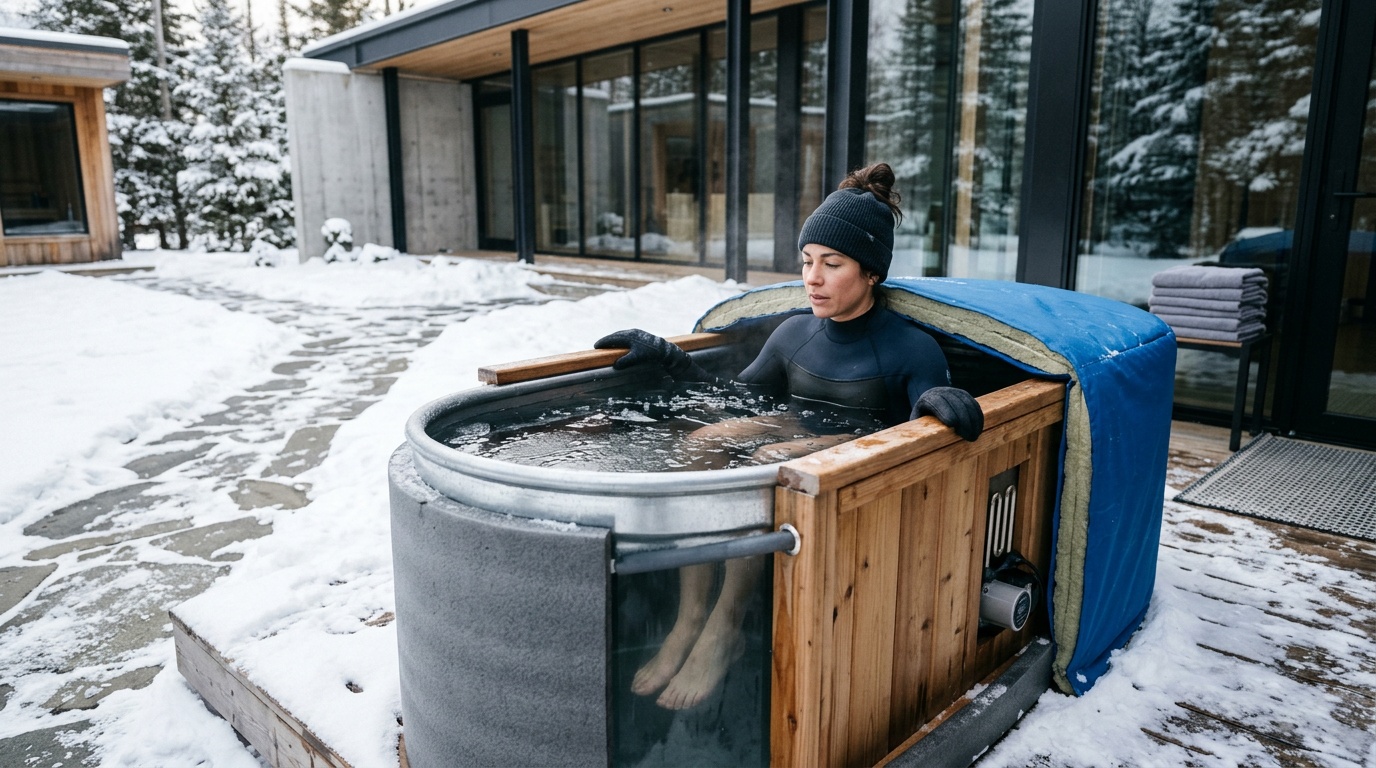
I treat an outdoor winter plunge as two separate jobs: controlling the exposure for the athlete and protecting the equipment between sessions. You can keep a cold plunge outdoors in winter, but only within its manufacturer’s operating limits, with a clear exit route and a plan for freezing weather or power loss.
My coaching rule is simple: winter should make cooling cheaper, not make the session harder. If the water is approaching freezing, the steps are iced over, or the plumbing cannot be protected, move the session indoors or shut the system down.
This cold plunge outdoor winter guide covers the decisions that matter: what can stay outside, how to prevent freeze damage, and how to keep a recovery session from becoming another stressor.
1. Choose your winter operating plan before the first freeze
Outdoor-rated does not automatically mean freeze-rated. A weather-resistant cabinet may tolerate rain while its heat exchanger, filter housing, or hoses remain vulnerable to frozen water. Read the manual for the exact tub and chiller combination, including minimum ambient temperature, shutdown instructions, and freeze-damage warranty exclusions.
Get clarification from the manufacturer if its sales page and manual disagree. For example, Plunge’s Evolve winterization instructions call for winterizing when outdoor temperatures fall below freezing, including emptying the chiller and bringing it indoors. That is a model-specific instruction, not a universal temperature rating for every plunge.
| Winter situation | Practical operating plan | Main limitation |
|---|---|---|
| Temperatures remain above freezing | Use the system within its published ambient limits; measure water before entry. | Water can still become colder than your intended session temperature. |
| Occasional overnight freezes | Use only explicitly approved freeze protection, or drain and winterize before the freeze. | A mild afternoon does not protect exposed plumbing overnight. |
| Repeated or prolonged subfreezing weather | Move to a suitable temperature-controlled space or use a system expressly rated for those conditions. | Insulation alone cannot maintain temperature indefinitely. |
| Travel, unreliable power, or no daily checks | Complete the manufacturer’s winter shutdown procedure. | Active freeze protection depends on functioning equipment and power. |
My first judgment call: if you cannot explain what happens during an overnight outage, the setup is not ready for unattended winter operation. A temperature alert helps you notice trouble; it does not prevent freezing.
2. Protect the entire water circuit
Insulate the tub, but inspect the small components
The visible water surface is only part of the system. Small volumes trapped in valves, pump housings, filters, and exposed hoses can freeze while the main tub still looks usable. Expanding ice can damage these components and produce leaks when temperatures rise.
Use the manufacturer’s fitted insulated cover and approved insulation for exposed lines. Keep equipment ventilation and service access clear. A cover slows heat loss and limits debris; it does not generate heat. Likewise, circulating water is not a guarantee against freezing during sustained cold.
If your system has heating or automatic freeze protection, confirm which components it protects, its minimum outdoor operating temperature, and whether it must remain powered continuously. A chiller that can heat the tub is not necessarily approved for every winter climate.
Build a shutdown plan you can actually execute
Before bad weather, locate every drain and identify where discharged water will go. Keep the model’s instructions accessible without relying on a working internet connection. The exact sequence varies, but a complete shutdown generally needs to address:
- The tub basin and its low points.
- The pump, chiller or heat exchanger, and connecting hoses.
- Filter housings, valves, and other places that retain water.
- Dry storage and protection from rain or snow refilling drained parts.
Follow the manufacturer’s power-isolation and drainage sequence. Do not improvise compressed-air pressure, tip heavy machinery, or assume opening the tub drain empties the chiller. Some designs need service help to remove trapped water.
Never add automotive antifreeze to bathing water. Salt and improvised chemical mixtures are not substitutes for approved freeze protection; they can also conflict with equipment and sanitation requirements. Avoid livestock de-icers or bucket heaters unless the complete application is specifically approved for human immersion by the relevant manufacturers.
If freezing has already occurred, keep people out and do not force a pump to run against an ice blockage. Follow the manufacturer’s thawing guidance, then inspect for leaks and damaged fittings before restarting. Do not chip ice against the liner or pour boiling water onto components.
3. Build the exit route before filling the tub
Choose a level, load-rated surface close to a warm indoor space. Water weighs about 8.34 pounds per US gallon: 100 gallons adds roughly 834 pounds before the tub and occupant. Get a structural assessment before placing that load on a deck or balcony.
Install stable steps and a secure handhold appropriate to the tub. Provide lighting, traction, and drainage so splashed water does not create tomorrow’s ice patch. Keep the route clear of hoses, snow, and loose mats. A windbreak can improve the changing area, but must not obstruct equipment airflow.
For powered systems, have a qualified electrician verify the outdoor installation, grounding or bonding where applicable, and ground-fault circuit-interrupter protection. CPSC’s pool and spa electrical guidance identifies faulty wiring and electrical equipment near water as potentially fatal hazards. Keep connections away from standing water and snowmelt; do not solve a poor location with improvised extension-cord arrangements.
Secure the tub against unsupervised access by children and pets. An ordinary thermal lid is not necessarily a safety cover or a substitute for required barriers.
My second judgment call: put money into access and measurement before buying a more powerful chiller. A digital water thermometer rated for cold plunge temperatures is useful even with a built-in display. Check its specified range and accuracy; measure the bathing water, not just the weather.
4. Understand what winter changes in your body
Cold water can trigger an involuntary gasp, rapid breathing, and cardiovascular strain before hypothermia develops. The National Weather Service’s cold-water safety guidance emphasizes that cold shock can quickly interfere with breathing and movement. Being a strong swimmer does not remove that response.
Winter also adds exposure before and after immersion: bare feet on cold ground, wet skin in wind, and time spent struggling into clothes. The water temperature alone does not describe the whole session.
Speak with your clinician before starting if you have cardiovascular disease, high blood pressure, a history of fainting, or another condition that could affect your response. Mayo Clinic specifically advises medical review for cardiovascular risk factors. Cold-triggered allergic reactions, impaired sensation, and circulation problems also deserve individual guidance.
Do not plunge alone, after alcohol, or while unwell. Keep your head above water, enter under control, and never combine immersion with hyperventilation or breath-holding. Have another adult present who can help you exit and call for assistance.
5. Use a conservative, measured winter protocol
There is no validated temperature-and-time formula that guarantees safety for everyone. For a healthy adult cleared to participate, I would begin around 55–59°F (13–15°C), with only 30–60 seconds planned, and permission to leave immediately. This is a conservative coaching starting point, not a proven minimum effective dose or a safety guarantee.
If an unheated tub has fallen below that planned range, adjust the water using an approved method and remeasure, or skip it. Do not translate a familiar session into near-freezing water by guessing a shorter duration.
- Check conditions: measure water temperature, inspect footing and equipment, and confirm immediate indoor access.
- Prepare the exit: place a towel, dry layers, and footwear within reach; have your helper present.
- Enter slowly: keep a stable handhold and your airway clear. Exit if breathing becomes uncontrolled.
- End early when needed: leave for dizziness, chest discomfort, unusual breathlessness, numbness, loss of coordination, or distress. A timer is a ceiling, not a target.
- Rewarm indoors: dry off promptly, remove wet clothing, and put on warm layers. Avoid standing outside to finish a conversation or video.
My third judgment call: hold temperature and duration steady while assessing how you respond. Log the exposure, how quickly you feel normal afterward, and whether it improves your next training session. Persistent shivering or prolonged difficulty warming up is a reason to stop and reassess, not progress.
Confusion, slurred speech, marked clumsiness, or unusual drowsiness can signal hypothermia. Call emergency services for these signs, chest pain, fainting, or serious breathing difficulty. Move the person to shelter, remove wet clothing, and warm the torso under dry layers while awaiting help. CDC’s hypothermia guidance treats suspected hypothermia as a medical emergency. Do not wait for a thermometer reading before seeking help.
6. Match the plunge to the recovery goal
A 2025 systematic review and meta-analysis included 11 studies and 3,177 participants, using water temperatures of 7–15°C. It found time-dependent effects, including reduced stress at 12 hours, but no significant immediate immune-function improvement. The authors flagged limited trials and limited population diversity.
That research does not establish that near-freezing water produces better recovery, or that a winter plunge prevents illness. It also combines different exposure methods and protocols; a large participant total does not validate one backyard routine.
For lifting, timing matters. A 2024 meta-analysis of resistance training and cold-water immersion suggested that repeatedly plunging immediately after training may modestly reduce muscle growth, with uncertainty from the quality and size of the evidence base.
My fourth judgment call: when hypertrophy is the priority, I avoid making immediate post-lifting immersion a habit. I would place optional plunges on a separate day rather than promise that waiting a specific number of hours eliminates the tradeoff. During tightly scheduled competition, short-term soreness management may matter more. Choose deliberately, and keep sleep, food, and training load at the center of recovery.
7. Keep winter maintenance boring and consistent
Cold water is not sterile. Continue the tub manufacturer’s cleaning, filtration, and water-treatment routine, using compatible test supplies and specified chemical ranges. Clear water alone does not establish that it is hygienic.
Before each use, inspect temperature, flow, leaks, and access. During freezing weather, check the forecast and equipment as often as the manufacturer requires. Clean or replace filters on schedule; restricted flow can undermine systems that depend on circulation.
If you disconnect the chiller for winter, confirm whether you have also removed filtration or sanitation functions. The remaining tub needs its own approved water-care routine. Drain-and-refill setups still require cleaning and a drainage route that will not freeze across a walkway.
8. Outdoor winter cold plunge FAQ
Can you leave a cold plunge outside all winter?
Only if its complete system is rated for the actual conditions and you can meet its operating requirements. Otherwise, winterize it or relocate it to a suitable temperature-controlled space. An unheated garage may still freeze.
Will an insulated cover stop the tub freezing?
It slows heat loss but cannot prevent freezing indefinitely. It also does not protect every external hose, valve, or filter housing. Follow the system’s freeze-protection instructions.
Do you need a chiller in winter?
You may not need mechanical cooling, but the unit may also provide circulation, filtration, or heating. Do not simply unplug a water-filled chiller and leave it exposed to freezing temperatures.
How cold is too cold for a winter plunge?
There is no universal safe cutoff. Near-freezing water provides little margin for error and is unnecessary for a basic recovery routine. Use a measured, conservative temperature; do not treat floating ice as a performance goal.
Should you break the ice and get in?
I would cancel the session. Ice means the water is outside the conservative protocol above and equipment may already be affected. Restore safe conditions and inspect the system before considering another plunge.